I hope you all had a LOVELY long weekend and survived this stunning heatwave we’ve been having (in the UK). I think I lost about a kilo just walking to the shop this morning lol.
Anyway.
Right now, there’s a TikTok/Instagram/YT account called chloe vs history doing extremely well.
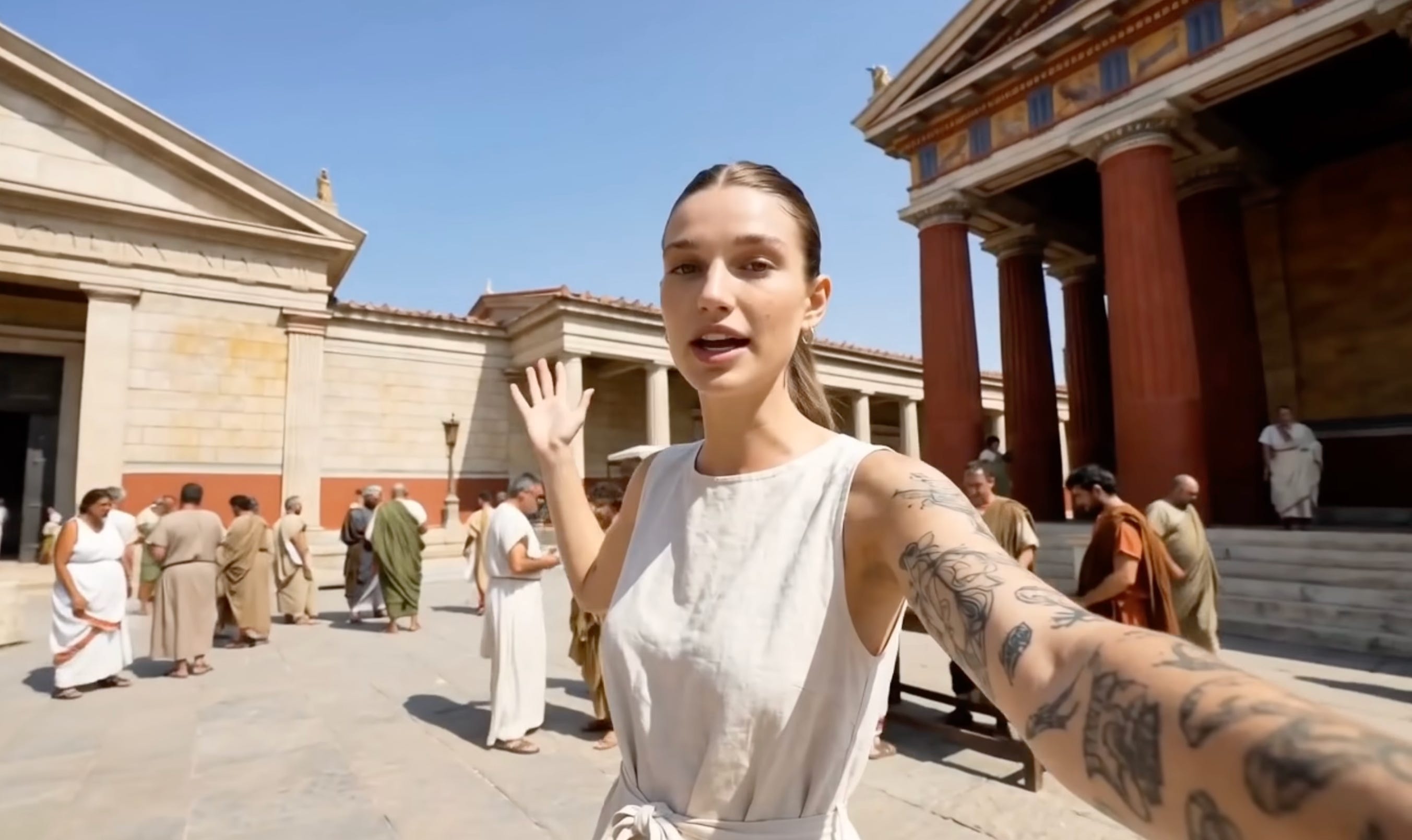
The premise is an American woman who’d somehow got “lost in history” - time travelling through different moments in history and reacting to them on camera, as if it were a vlog.
Pompeii, Rome, the Black Death, the Titanic, etc.
The channel has nearly 1M total followers, with YouTube videos doing upwards of 2.1M views.
The comment sections full of “this is the best thing on my feed right now” and teachers flagging it as something they were starting to show in class as a kind of historical illustration aid.
And then in early May, Sky News did some digging.
Chloe turns out to be a man called Jonathan Laramy.
Jonathan is a British millennial who lives in Gloucestershire. There is no Chloe, there never was. Chloe is an AI character, generated and prompted and moved through history scenes.
There’s an interesting set of questions buried in this story…
Level 1: the audience didn’t care
When the Sky News piece broke, the most striking reaction was a sort of shrug.
Their argument was something like, well, the historical scenes are still accurate, the format still works as a hook, and people engage with it. Which raises a question I think a lot of us in the content industry are going to have to wrestle with quite carefully over the next couple of years. Which is: if AI content is useful - educationally, emotionally, comedically - does the fact that it’s AI-generated and the host doesn’t exist devalue it? The answer most of us in the creator space have been instinctively giving for a couple of years now is yes, of course it does, authenticity is everything. And then a guy in Gloucestershire builds an 1M follower strong history account using a fake American AI girl and people just sort of go fair enough. That should give all of us a bit of pause.
Level two: What does this mean for everybody who is a real human being making content?
Because this whole story is, structurally, very bad news for actual creators.
If Jonathan can build an audience of nearly 1M in a relatively short time frame months using an AI engine, I can only assume that the cost of producing convincing creator-style content has just collapsed. Which means the supply curve for “content that looks like it was made by a person” is about to go absolutely vertical. Which means being a real person making real content is, paradoxically, about to become more valuable, not less - but only for the people whose realness is unmistakable. Whose specificity is so high it can’t be faked.
The AI characters of history will likely multiply after Jonathans success.
The specific, weird, undeniable humans will be fine, I think.
The middle - the polished, maybe generic-ish, content that already feels half-AI even when it’s made by real people - that middle is in genuine trouble.
A few smaller things worth flagging before I wrap up.
We are now living in a world where the marginal cost of a fake person is approaching zero, and the institutional response to that - by platforms, by educators, by audiences themselves - has barely started.
This story is the leading edge of a wave that’s going to redefine what content even is over the next five years. Some of it will be great, a lot of it will be mediocre and most of it will be invisible - in the sense that you’ll consume it without realising what it is.
Jonathan built something that has educational value, audience traction and a strong format.
He’s an early operator in a new category of media (he actually spoke on a podcast in March covering his thesis behind the whole thing, have a watch below).
The lazy take is to mock the guy.
The smart take is to study what works about it and then make sure the version you’re doing can’t be replicated by a chatbot.
Anyway. Wherever Chloe is right now, I think we should all keep an eye on this story.
Stay specific, stay real and stay weird.
Before you go, I wanted to flag an event happening at the end of the month. I think you’ll find it interesting if you haven’t already heard about it 👇
It’s called Press Publish, run by Colin and Samir - who you probably know already from their YouTube channel (which I was on a few years ago: subtle plug here) or their newsletter The Publish Press, which is one of the few things I read pretty much every week.
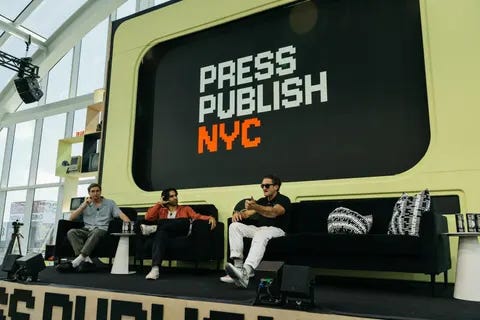
They ran the first one in New York last year with ~450 creators, 16 countries in the room and over 400 million combined followers. This year’s edition is in LA on May 28th at the Fox Studio Lot, and they’ve got around 500 creatives attending.
This is not sponsored, by the way (it’s already sold out anyway, waitlist only).
They’ve framed the event by saying:
For the last decade, the conversation has centered on what happens when Hollywood and creators “converge”. That conversation is behind us. Creators and Hollywood now operate inside the same entertainment system. What matters now is how we build within this new reality.
That’s the whole thesis. And honestly, yeah. That’s right.
As I keep saying over and over and over (you’re probably sick of it lol)…
a lot of people in this industry are still operating on the old mental model - creator world over here, real entertainment industry over there, what happens when they touch? That model broke probably a little over eighteen months ago. Colin and Samir are spot on to retire the question.
Look at who they’ve got speaking:
Johnny Harris, who left Vox to build Newpress - creator-led media company doing 14 million across platforms, Emmy nominations.
Kara McCloud, who’s been at MrBeast for six and a half years running people for a 500-person content operation.
Alessandra Catanese, now CEO of Smosh, who came up through Maker Studios and Patreon.
Scott Lewers, three-time Emmy winner out of Lionsgate and Warner Bros., who joined CrunchLabs last year as their first Chief Content Officer.
Billy Parks running FOX Creator Studios. Kim Larson from YouTube. The TBPN boys.
It’s not creators on one panel and execs on another. It’s the same people.
The lines have totally dissolved.
From my POV, this is a macro story. In music it’s labels and indie artists, in publishing it’s the Financial Times, In e-commerce it’s DTC brands and creator-built brands.
Whatever industry you’re in, there’s some version of this same thing happening right now - where the “official” players are being forced to reckon with the fact that creator-side operators are now inside the same system as them, not adjacent to it.
Anyway. I’m not in LA on the 28th, but I’ll be reading every recap, watching every clip, and listening to the live episode of The Colin and Samir Show they record from the stage. If you can get on the waitlist, do it. If you can’t, follow Colin and Samir, sub to The Publish Press, and pay attention to what comes out of that day.
Remember, the creator mindset is all you need to grow 🌱
Jordan
P.S.
When you’re ready, here’s three ways I can help out 👇️
P.P.S
If you enjoyed this, you’ll love Community Service, my co-written newsletter with Grace Andrews. Check it out using the link below.